 オフィシャル
August Cool Breeze Kabuki
– Part Three

Part Three of August Cool Breeze Kabuki at the Kabukiza Theatre is a program of dance performances that brings a refreshing sense of coolness to the height of the Japanese summer. It features two highlights: a spectacular performance by the Nakamura Brothers and their Children, and elegant Jiuta-mai performed by Tamasaburo Bando V, a Living National Treasure, Japan's highest honor for masters of traditional performing arts.
Bugaku Setsugekka (Dance of Snow, Moon, and Flowers)
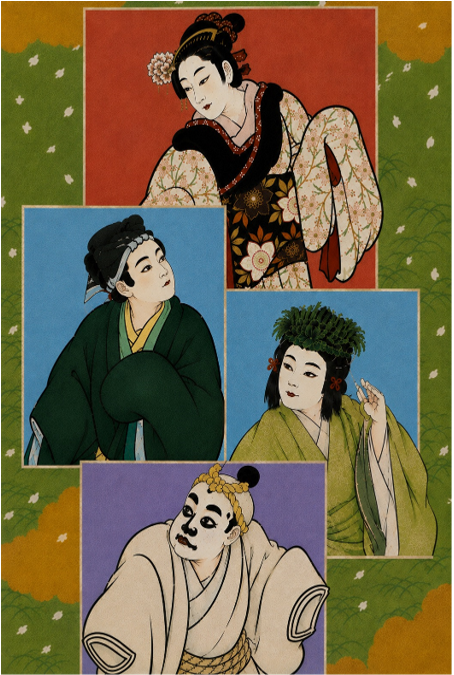
Bugaku Setsugekka is one of the signature dance works of the Nakamura family.
The 17th Kanzaburō was a Living National Treasure. His son, the 18th Kanzaburō, was a renowned child prodigy who passed away at 57. Fans eagerly await the succession of his eldest son, Nakamura Kankurō, to the Kanzaburō name.
The performance celebrates the beauty of Japan's four seasons through three scenes: Spring ("Cherry Blossoms"), Autumn ("Pine Cricket"), and Winter ("Snowman").
Spring – Cherry Blossoms
Beneath a magnificent weeping cherry tree, the Spirit of the Cherry Blossom appears and dances gracefully.
The elegant beauty and refined movements of the onnagata—a male Kabuki actor specializing in female roles—perfectly express the vitality and splendor of spring.
Autumn – Pine Cricket
A young pine cricket becomes separated from its parent. The two are finally reunited under the autumn moon.
This lyrical dance portrays the deep bond between parent and child through the world of insects, reflecting universal human emotions.
Winter – Snowman
The final scene tells the charming story of a snowman who falls in love with a charcoal maker's daughter.
The more deeply he falls in love, the faster he melts. The result is a delightful blend of comedy and bittersweet emotion—a hallmark of the Nakamura family's style.
Jiuta-mai: Snow and Lingering Moon
What is Jiuta-mai?
To understand jiuta-mai, it may help to picture maiko and geiko gracefully dancing in the traditional banquet rooms of Kyoto’s geisha districts.
Even if you visit Kyoto, however, you cannot simply walk into a geiko’s banquet room and watch such a dance. Many of these establishments follow the traditional practice known as ichigensan okotowari, which means that first-time guests are generally not accepted unless they are regular customers or have been introduced by one.
But this time, you do not need to go to Kyoto. All you have to do is take a seat in the audience at Kabukiza Theatre.
And there is something even more special: Bando Tamasaburo himself, one of Japan’s leading Kabuki actors and a designated Living National Treasure, performs this traditional art.This is truly a rare and luxurious opportunity.
Yuki (Snow)
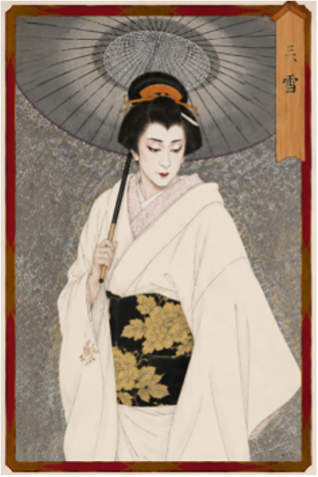
Jiuta-mai is a traditional Japanese dance performed to jiuta, a style of shamisen music.
Jiuta-mai has no flashy movements. Instead, it emphasizes subtle and delicate gestures, such as slight movements of the eyes and the handling of a fan or sleeves.
Through these small gestures, the dancer expresses the character’s emotions, the changing seasons, and a sense of lingering emotion.
Yuki is a masterpiece of jiuta dating from the 1780s.
The protagonist is Soseki, a geisha who actually lived in Osaka. She was once a popular geisha, but she has since become a Buddhist nun.
On a snowy night, Soseki spends the evening alone and quietly. She remembers a night in her youth when she waited for her lover.She hears the distant sound of a temple bell. The sound makes her feel lonely.
Later, she hears footsteps in the quiet of the night. She imagines that her lover has come to see her.Her memories gradually become more vivid. The memory of a love she tried, but could never forget, comes back to her amid the quietly falling snow.
Zangetsu (The Lingering Moon)
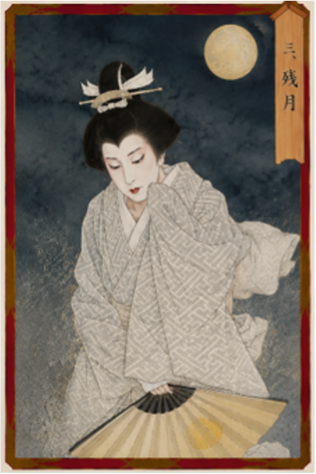
Zangetsu is said to have been created to mourn a beloved pupil who died at a young age.
At first, the moon appears behind the pine branches by the sea. Gradually, the moon sinks into the sea. A dreamlike scene unfolds.Then, in the silence, a lone figure appears.
Is this figure the young woman who died? Or is it someone mourning her?
The dance continues to lyrics describing how the departed person lives on in the moon.The piece then moves into a beautiful passage performed only by the shamisen.
Amid the quiet music, an endless sense of grief emerges. We can also feel the fleeting nature of life.
With its refined melody and deep underlying sorrow, Zangetsu is a truly exquisite work of dance.